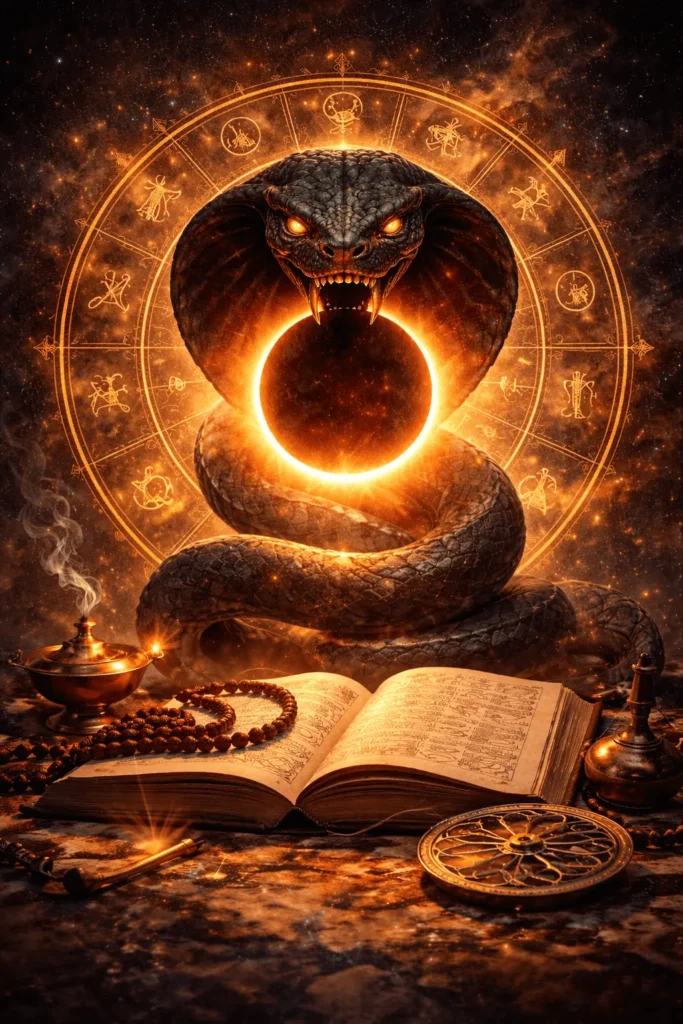
Introduction: Representation Is Not the Same as Meaning
When people ask what does Rahu represent in Vedic astrology, they often expect a list of effects—good or bad. That’s the wrong way to approach Rahu.
Rahu does not represent events.
It represents patterns of desire and perception that drive those events.
This distinction is why Rahu is so often misunderstood.
Rahu as a Functional Force, Not a Physical Planet
Rahu is not a visible celestial body. It is a calculated point, formed by the intersection of the Sun and Moon’s paths. Because of this, Rahu does not act like Mars or Jupiter.
Instead of energy, Rahu represents psychological momentum.
Ancient Vedic texts describe Rahu as something that:
- Distorts perception
- Intensifies craving
- Pushes consciousness toward the unfamiliar
That description is symbolic, not mythological.
Core Psychological Themes Rahu Represents
1. Desire Without Saturation
Rahu represents want that doesn’t resolve.
Unlike Venus (pleasure) or Jupiter (growth), Rahu doesn’t know when to stop. This is why Rahu is linked to:
- Ambition that never feels complete
- Success followed by dissatisfaction
- Constant comparison with others
This isn’t punishment. It’s a psychological drive.
2. Illusion as Misjudgment, Not Magic
Illusion does not mean hallucination or deception by others.
Rahu represents:
- Overestimating outcomes
- Misjudging risks
- Believing “more” will fix discomfort
This explains why strong Rahu often pushes people into:
- Risk-heavy careers
- Fast growth situations
- Trend-driven decisions
3. Unconventional Paths and Identity Shifts
Rahu represents movement away from inherited patterns.
This includes:
- Breaking family traditions
- Choosing unusual professions
- Living in foreign or unfamiliar environments
People with dominant Rahu often feel disconnected from “normal” life paths—and that’s not accidental.
How Rahu Influences Career and Life Direction
Rahu does not choose the career.
It influences how decisions are made.
In practical terms, Rahu affects:
- Risk tolerance
- Attraction to novelty
- Obsession with recognition
This is why Rahu is common in charts of people working in:
- Technology
- Media
- Politics
- Research
- Non-traditional businesses
But without discipline, the same Rahu leads to instability.
Why Modern Interpretations Often Fail
Many modern astrologers reduce Rahu to:
- Fear
- Past-life punishment
- Sudden disasters
That approach ignores Rahu’s functional role.
Rahu is not reactive.
It is directional.
It shows where consciousness wants experience, regardless of readiness.
Rahu in Practical Astrology (How It Should Be Read)
To understand what Rahu represents in a chart, you must analyze:
- The house it occupies
- The ruler of that house
- The planet controlling Rahu’s sign
- The balance with Ketu
Reading Rahu alone is meaningless.
This structured, chart-wide method is central to how AstroRishie approaches Vedic astrology—focusing on patterns, not fear narratives.
External Reference for Context
For readers interested in the astronomical basis of Rahu as a node, Britannica provides a neutral explanation of lunar nodes.
Final Insight
Rahu does not represent chaos.
It represents unfiltered desire moving toward experience.
When understood correctly, Rahu becomes one of the most practical tools in Vedic astrology—not for prediction, but for understanding human behavior and decision-making.