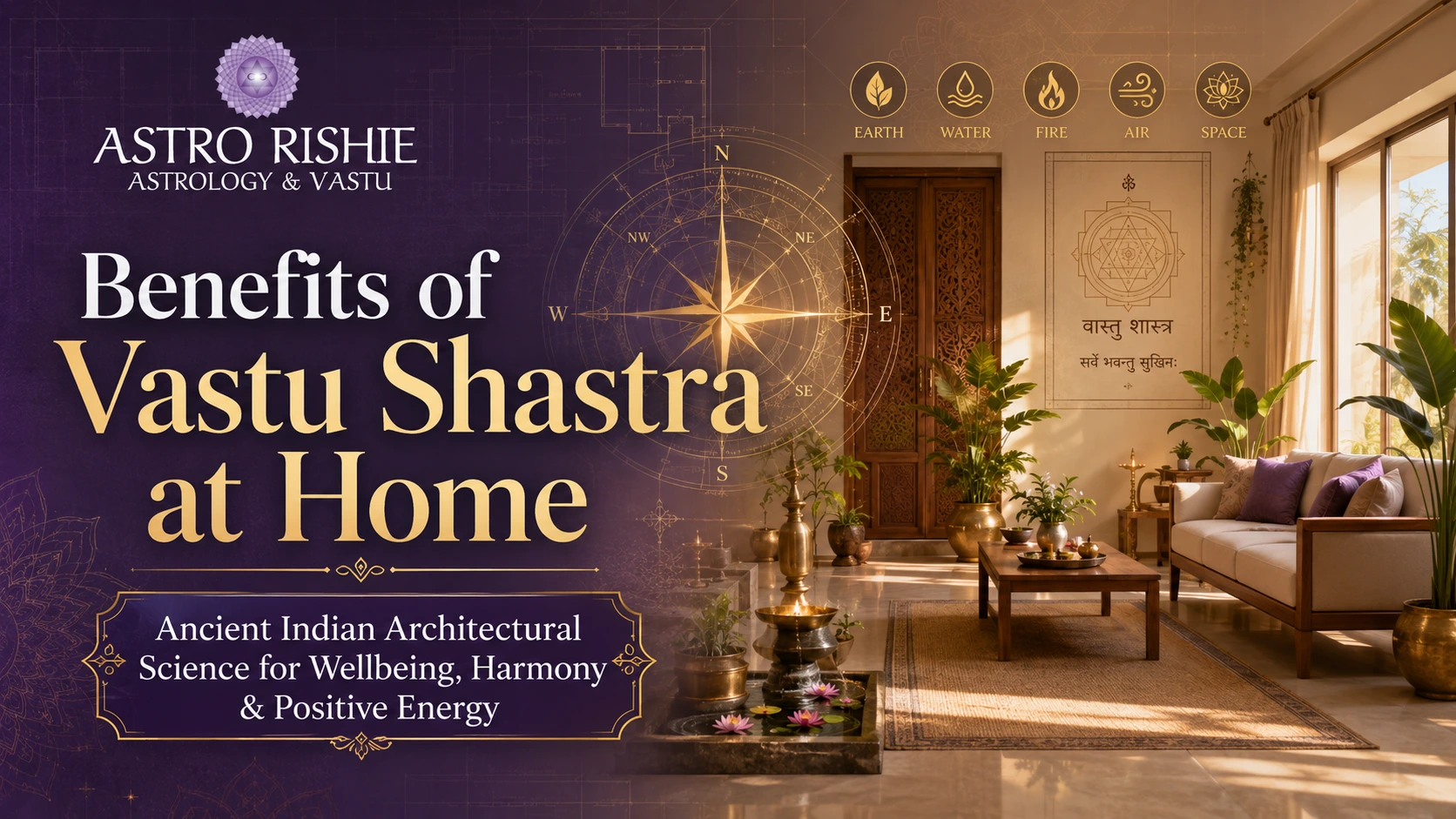
The Real Benefits of Vastu Shastra at Home: What Ancient Indian Architectural Science Actually Does for Your Life
*
If one happens to know of Vastu Shastra in Australia, they will likely come across it in one of two ways. Either from family – a parent or grandparent who insisted that the house be built or laid out in a particular way, an insistence that admitted no argument – or through casual interest, a passing memory that made them wonder if there was anything to it or if it was just another superstition to add to a long list of such nonsense.
Neither of these ways of approaching it does it justice; the reality is quite different.
Vastu Shastra is perhaps the oldest documented scientific knowledge of architecture, space, and energy in existence. Older than psychology, neuroscience, and modern architecture itself by thousands of years – and yet its fundamental principles concerning how the space around us affects our thoughts, feelings, sleep, interactions, and humanity in general are slowly being scientifically proven in environmental and cognitive psychology.
What Vastu Shastra Actually Is?
The word Vastu comes from the Sanskrit vas, meaning “to dwell” or “to reside.” Shastra means “science” or “body of knowledge.” Vastu Shastra, then, is literally the science of dwelling — a comprehensive, systematic body of knowledge about how built spaces interact with natural energies, and how those interactions affect the human beings living within them.
It is one of the six traditional Vedangas — auxiliary disciplines attached to the Vedas, the foundational texts of ancient Indian knowledge — and its origins are traced to texts including the Manasara, the Mayamata, and portions of the Arthashastra and Agni Purana, among others. The Manasara alone contains 70 chapters of remarkably detailed architectural guidance.
Vastu Shastra was not a niche or fringe tradition. It was the primary architectural framework used in the design of temples, palaces, cities, and homes across the Indian subcontinent for millennia. The town planning of the ancient city of Dholavira — part of the Indus Valley Civilisation, dating to roughly 3000 BCE — shows evidence of systematic spatial organisation consistent with Vastu principles. The great temples of South India, the palace complexes of Rajasthan, the stepwells of Gujarat — all designed within this tradition.
At its philosophical core, Vastu Shastra rests on a single foundational premise: the built environment is not neutral. The way a space is designed, proportioned, oriented, and arranged creates an energy environment that either supports or hinders the wellbeing of the people within it. The goal of Vastu is to create spaces that are in harmony with the natural forces operating around and through them — so that those forces support, rather than work against, human life.
The Five Elements: Vastu’s Scientific Framework
Vastu Shastra is built on the concept of the Panchabhutas — the five great elements that, in Vedic understanding, constitute all of physical existence. These are:
Prithvi — Earth: The element of stability, weight, and groundedness. Earth represents solidity, reliability, and the physical foundation of things. In a home, earth energy governs how stable and grounded the occupants feel — their sense of security, their physical health, and their connection to what is real and enduring.
Jal — Water: The element of flow, adaptability, and nourishment. Water governs the movement of energy through a space — both literal water features and the metaphorical flow of opportunity, abundance, and vitality. Where water energy is blocked or stagnant in a home, the corresponding areas of life tend to mirror that stagnation.
Agni — Fire: The element of transformation, energy, and illumination. Agni governs light, heat, and the metabolic processes of both the home and its occupants. Fire energy in a space affects vitality, confidence, clarity of thinking, and the transformative capacity of the people within it.
Vayu — Air: The element of movement, communication, and breath. Vayu governs ventilation, the circulation of fresh air, and the invisible movements of energy through a space. Air quality and flow in a home have direct, documented effects on cognitive function, mood, sleep quality, and respiratory health.
Akasha — Space (Ether): The subtlest of the five elements — the open, unoccupied space within a home that allows the other four elements to function and breathe. Akasha governs consciousness, sound, and the quality of awareness within a space. In Vastu, the preservation of appropriate open space – particularly at the centre of a home – is considered fundamental to the wellbeing of its occupants.
Vastu Shastra, in its practice, works to ensure that all five elements are present, balanced, and harmoniously expressed within a built space. When any element is deficient, excessive, or blocked, the imbalance is felt – not as an abstract metaphysical problem, but as a lived experience in the daily life of the home’s occupants.
The Brahmasthan: The Living Heart of the Home
One of the most distinctive and important concepts in Vastu Shastra is the Brahmasthan — literally “the place of Brahma,” the creator.
The Brahmasthan is the central zone of any home or built space. In Vastu, this centre is treated as the energetic heart of the entire structure – the point through which cosmic energy enters and radiates outward to every room and corner of the home. It corresponds to the Akasha element, the element of space and consciousness.
Vastu Shastra teaches that the Brahmasthan should be kept open, uncluttered, and unburdened. Heavy structures, walls, beams, pillars, or significant weight placed at the centre of a home are considered disruptive to the natural circulation of energy from this central point outward.
The practical implications of this are striking when you consider them through a contemporary lens. A home with an open, well-lit, uncluttered centre tends to have better natural ventilation – air circulates more freely through an open central space. Natural light penetrates more deeply. There is a quality of spaciousness and ease that most people feel immediately, even if they couldn’t articulate why. The Brahmasthan principle, stripped of its metaphysical language, is essentially a principle of good spatial design: leave the heart of the space to breathe, and the whole home breathes better.
Benefit 1: Improved Sleep Quality and Physical Health
One of the most consistently reported benefits of living in a Vastu-compliant space is a marked improvement in sleep quality — and this has genuine physiological grounding.
Sleep is governed, physiologically, by the body’s response to light, electromagnetic fields, and the subtle environmental cues that signal safety or threat to the nervous system. A bedroom that receives appropriate natural light during the day (supporting a healthy circadian rhythm), that has good ventilation (supporting oxygen quality during sleep), and that is free of disruptive electromagnetic interference from heavy electrical equipment placed directly around the sleeping area, is demonstrably better for sleep than one that lacks these qualities.
Vastu Shastra’s principles around bedroom design — the quality of the room’s proportions, the ventilation, the avoidance of clutter and disruptive elements in the sleeping space — align closely with what sleep scientists describe as good sleep hygiene from an environmental standpoint.
Beyond sleep, physical health benefits associated with Vastu-compliant homes consistently relate to two factors: air quality and light. Homes designed with good cross-ventilation – so that fresh air moves through the space rather than stagnating — support respiratory health, immune function, and cognitive clarity. Homes with well-considered natural light exposure support vitamin D synthesis, mood regulation through the serotonin-melatonin cycle, and the general wellbeing that comes from living in a space that feels alive rather than dim and closed.
These aren’t mystical benefits. They’re the biological consequences of living in a space that breathes.
Benefit 2: Mental Clarity and Reduced Stress
The relationship between the built environment and mental health is one of the most actively researched areas in contemporary environmental psychology — and the findings consistently support what Vastu Shastra has asserted for millennia.
The spaces we inhabit shape our minds. This is not a figure of speech. The quality of light in a space affects serotonin production. The degree of clutter in an environment creates measurable cognitive load — a low-level but constant drain on mental processing capacity. Noise levels, ceiling heights, the ratio of open space to enclosed space, the presence or absence of natural elements, the quality of ventilation — all of these environmental factors have documented neurological effects.
Vastu-compliant spaces tend to embody several features that environmental psychology has identified as stress-reducing:
Open, uncluttered living areas. Clutter isn’t merely aesthetically displeasing — it’s cognitively taxing. Research at the Princeton Neuroscience Institute has shown that physical clutter competes for attention with the task at hand, reducing focus and increasing stress hormones. Vastu’s emphasis on maintaining clear, uncluttered spaces — particularly in the central and primary living areas — reduces this cognitive load and creates an environment where the mind can settle rather than perpetually scanning.
Proportional spaces. Vastu Shastra pays careful attention to the proportions of rooms — their length-to-width ratios, ceiling heights, and the relationship between open and enclosed areas. Architectural psychology has confirmed that rooms with harmonious proportions feel more comfortable and less anxiety-inducing than spaces with irregular or extreme proportions. There’s a quality of rightness to well-proportioned rooms that the nervous system registers as safe.
Integration of natural elements. Vastu places considerable emphasis on the presence of natural materials, living plants, water, and natural light within the home. The biophilia research of E.O. Wilson and subsequent environmental psychologists has confirmed what Vastu assumed: human beings have an innate, evolved response to natural environments, and the presence of natural elements in built spaces measurably reduces cortisol, lowers blood pressure, and improves mood and cognitive function.
Acoustic consideration. Vastu Shastra includes detailed guidance on how sound behaves within built spaces and how to design spaces that support acoustic harmony rather than amplifying noise and reverberation. Chronic exposure to noise — even low-level background noise — is one of the most consistent contributors to stress and cognitive fatigue. Spaces designed with acoustic thoughtfulness are quieter, calmer, and more restorative.
The cumulative effect of living in a space that embodies these qualities — day after day, year after year — is a measurably different baseline of mental and emotional wellbeing than is available in a space that works against them.
Benefit 3: Harmonious Family Relationships
This might sound like the most difficult of Vastu’s claimed benefits to substantiate — how can the design of a space affect the quality of relationships between the people within it?
But the evidence, when you look at it, is actually quite compelling.
Space shapes behaviour. The way a home is laid out determines how people move through it, where they naturally congregate, when they’re in proximity to one another, and when they have natural separation and privacy. A home that lacks adequate private spaces creates friction — people have no refuge from one another when they need to withdraw and recharge. A home that lacks adequate communal spaces creates isolation — there is no natural gathering point around which family life can organically centre.
Vastu Shastra gives considerable attention to the function and character of different zones within a home. The spaces for gathering, for eating together, for quiet and sleep, for work, for children — each has its own quality and its own requirements for the energy it needs to hold. A home in which these zones are thoughtfully distinguished tends to be one in which the different rhythms of family life can coexist without constantly colliding.
The kitchen is central to family harmony in Vastu. The kitchen in Vedic tradition is governed by the Agni element — fire — and is considered the space of nourishment, transformation, and the daily renewal of the family’s physical vitality. Vastu Shastra treats the kitchen with particular care, emphasising that it should be a space of light, cleanliness, and good ventilation — that the act of preparing food should happen in an environment that supports clarity, care, and positive energy.
From a purely psychological standpoint, the evidence is clear: families who eat together regularly have stronger bonds, better communication, and lower rates of a range of social problems. The environment in which food is prepared and shared has a genuine effect on whether those rituals feel like a pleasure or a burden.
Light and mood are intimately connected. Darkness and poor lighting are associated with low mood, irritability, and reduced emotional regulation. A Vastu-compliant home prioritises natural light throughout its primary living spaces — not as decoration but as a fundamental requirement of human wellbeing. Families living in light-filled spaces are demonstrably in better moods, more patient with one another, and more capable of resolving conflict constructively than those living in chronically dim environments.
Benefit 4: Enhanced Prosperity and Professional Clarity
Vastu Shastra has long been associated with the support of prosperity — not in a magical, wish-fulfilling sense, but through the more grounded mechanism of how the energy of a space affects the mindset, focus, and productive capacity of the people within it.
A well-designed workspace within the home — one that has adequate light, good ventilation, appropriate proportion, and freedom from the energetic distractions of clutter — supports cognitive function, sustained focus, and creative thinking in ways that a poorly designed workspace demonstrably does not.
The contemporary research on work-from-home productivity is essentially confirming what Vastu Shastra has always maintained: the environment in which you work shapes the quality of work that’s possible within it. People who work in spaces with natural light are more alert and productive. People who work in clean, well-organised environments make better decisions and retain information more effectively. People who work in spaces that feel energetically “right” — calming, clear, and well-proportioned — report higher satisfaction and lower burnout than those working in chaotic, poorly lit, or cramped environments.
The Vastu principle at work here is the Akasha element — the importance of open, uncluttered space that allows the mind to expand rather than contract. A workspace (or a home environment that spills into professional life) that embodies this principle is one that actively supports the mental states — focus, creativity, lateral thinking, sustained effort — that lead to professional outcomes.
There’s also a subtler mechanism worth naming: a home that feels harmonious reduces the cognitive and emotional overhead of daily life. When the domestic environment isn’t a source of friction — when the morning routine flows rather than creates stress, when the evening is genuinely restorative rather than just a different kind of exhausting — the energy available for professional life is genuinely greater. Vastu’s benefits for prosperity aren’t separate from its benefits for wellbeing. They are the same benefit, experienced in different arenas.
Benefit 5: Deeper, More Restorative Rest and Spiritual Wellbeing
In Vedic understanding, the home is not merely a functional shelter. It is a sacred space — the environment in which the most intimate, vulnerable, and essential aspects of human life unfold. Birth, death, illness, love, grief, prayer, rest — all of these happen in the home. The quality of that container matters enormously.
Vastu Shastra treats the home with the same care and intention that it brings to the design of temples — because, in the Vedic worldview, the home is a kind of temple. The threshold between the outer world and the inner life of the family. The place where the sacred and the everyday meet.
This orientation toward the home as sacred space has a profound practical implication: it shapes how you relate to and inhabit your home. A home that is designed and maintained with genuine care — that is clean, uncluttered, well-lit, harmoniously proportioned, and filled with natural elements — feels different to live in than one that is treated as purely utilitarian. That difference is felt in the nervous system, in the quality of rest available within it, and in the ease with which spiritual practice or inner reflection becomes possible.
The Vedic concept of Griha — which translates as both “home” and “that which grasps or holds” — suggests that the home is not merely a backdrop to life but an active participant in it. The energy of a home holds its occupants in a particular way. A home that holds its occupants with care, clarity, and harmony creates conditions in which genuine rest is available — the kind of rest that is truly restorative, where the nervous system can complete its daily cycle of regulation and return to a state of ease.
For those with a spiritual practice — meditation, prayer, yoga, or any form of inner work — the quality of the home environment has a direct bearing on the depth of that practice. A home that is energetically clear and harmonious is one in which the mind settles more readily, distraction arises less persistently, and the stillness that inner practice requires is genuinely accessible.
Benefit 6: A Sense of Belonging and Emotional Rootedness
One of the less commonly discussed but deeply significant benefits of Vastu-compliant living is the quality of belonging it cultivates — the felt sense that a home is genuinely yours, genuinely supportive, genuinely a place you want to return to.
In contemporary life, many people live in spaces that function adequately but don’t genuinely nourish. The apartment is fine. The house does the job. But there’s no real sense of the space holding or supporting you — no quality of genuine home.
Vastu Shastra’s emphasis on creating spaces that are in harmony with natural forces, that are proportioned to support human wellbeing, and that treat the home as a living environment rather than a static container creates something that is increasingly rare: a home that feels like a home. A space whose energy is genuinely supportive of the people within it.
This quality of genuine belonging — of feeling truly at home in one’s own space — has profound effects on emotional wellbeing, on the quality of relationships within the home, and on the sense of stability and groundedness that supports everything else in life. When home is genuinely a refuge — not in a closed-off, escapist sense but in the sense of being a place that replenishes rather than drains — the whole texture of daily life changes.
The Prithvi element in Vastu — Earth, the element of stability and groundedness — governs this quality. A home that embodies healthy Prithvi energy is one whose occupants feel stable, rooted, and genuinely at home in their own lives. That’s not a small thing. In a world that often feels destabilising and uncertain, a home that provides genuine rootedness is an extraordinary gift.
Vastu Shastra and Modern Architecture: A Conversation Centuries in the Making
It’s worth stepping back for a moment to consider the broader picture.
Vastu Shastra is a 5,000-year-old science. And yet its core principles — the importance of natural light, cross-ventilation, proportional spaces, connection to natural elements, the psychological impact of clutter and openness, the acoustic quality of built spaces, the role of the home environment in supporting or undermining mental and physical health — are precisely the principles that contemporary sustainable architecture, biophilic design, and environmental psychology are converging on.
This isn’t coincidence. It’s the gradual convergence of two traditions — one ancient and intuitive, one modern and empirical — on the same fundamental truth: the spaces we inhabit are not neutral. They shape us, every day, in ways both subtle and significant.
Biophilic design — one of the most rapidly growing movements in contemporary architecture — is built on the principle that built environments should integrate natural elements: natural light, natural materials, living plants, water features, views of the natural world. This is Vastu Shastra, expressed in the language of twenty-first century architectural theory.
WELL Building Standard — a global certification framework for buildings designed to support human health and wellbeing — evaluates buildings across dimensions including air, water, nourishment, light, movement, thermal comfort, sound, materials, mind, and community. Read through those dimensions and you are, essentially, reading a contemporary translation of Vastu Shastra’s five elements and their application to built space.
The conversation between ancient wisdom and modern science is happening. And in the domain of how built spaces affect human wellbeing, Vastu Shastra is not on the fringe of that conversation. It’s at its centre.
Living With Vastu: The Cumulative Effect
The benefits of Vastu Shastra are not dramatic, overnight transformations. They are cumulative, gradual, and experienced over time — the way that any genuine improvement in the quality of one’s environment makes itself felt.
Better sleep, night after night. Clearer thinking in a workspace that supports rather than drains. Family meals in a kitchen that feels nourishing to be in. Mornings that begin in a bedroom whose energy is calm rather than chaotic. Evenings in a living space that genuinely allows the nervous system to decompress.
The individual improvements are often subtle. The cumulative effect, over months and years, is a quality of daily life that is measurably and noticeably different from one experienced in a space that works against you.
This is what Vastu Shastra promises — and, when applied with genuine understanding of its principles, consistently delivers. Not magic. Not superstition. Not the rearrangement of furniture as a substitute for genuine life choices.
A science of space, developed over millennia, in service of a single purpose: to create homes that support the full flourishing of the human beings within them.
That’s a purpose as relevant in a home in Sydney or Melbourne today as it was in the cities of the ancient Indus Valley thousands of years ago.
Want to understand how Vastu Shastra applies to your specific home and living situation? Connect with Astro Rishie for a personalized Vastu consultation that brings genuine Jyotish wisdom to your space and your life.*