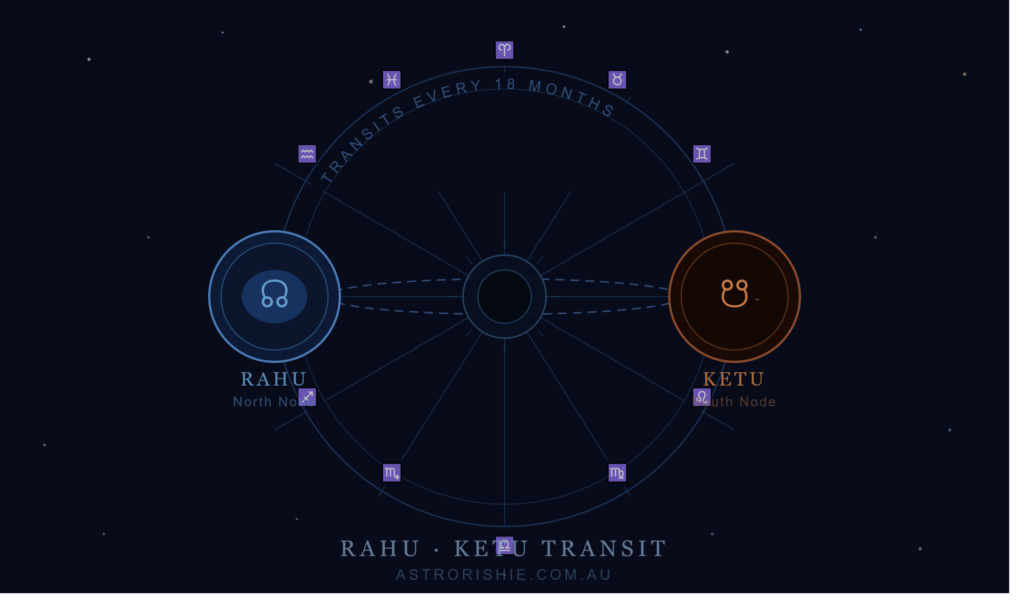
They are referred to as the North Node and the South Node in Western astrology; the mathematical points on the orbit of the moon that constitute the axis of karma and destiny. There is no lack of awareness of these two nodes within this system of astrological calculation.
However, in Vedic astrology, the ancient Indian tradition known as Jyotish – a literal translation of which means “the science of light” – there is far more significance and importance placed on these two mathematical points.
In Jyotish, they are known as Rahu and Ketu. These two nodes are not relegated to any kind of backseat within the Vedic framework of astrology. These two nodes have the power and strength of full Grahas, celestial entities, and are some of the most important and formidable placements within an entire birth chart.
Rahu represents the head of a severed cosmic serpent; Ketu represents its tail. These two together form an axis that runs throughout your Vedic birth chart and reflects the karmic legacy of your soul.
This is a quick overview; there is a great deal more to be learned about this fascinating concept.
What Rahu and Ketu Actually Are ?
Astronomically speaking, Rahu and Ketu are equivalent to the Lunar Nodes – the points on the ecliptic where the orbits of the Moon cross the ecliptic.
It is the special significance of the nodes, the exact points of conjunction of the Moon and the ecliptic, that makes them eclipse points. If there is a New Moon at the position of Rahu or Ketu, there is a solar eclipse; if the Full Moon occurs at these points, it causes a lunar eclipse. This is no mere coincidence; according to the Vedic tradition, it is exactly how the shadow points devour the light of the Sun and Moon.
As the ascending node of the orbit of the Moon, Rahu is the point where the Moon crosses upward into the ecliptic. On the other hand, Ketu is the descending node of the Moon – where it crosses downward into the ecliptic. These two points are always in opposition, always exactly 180 degrees apart, always forming the axis.
Being mathematical points calculated on the basis of positions of other planets, Rahu and Ketu in Vedic Astrology are referred to as the Chaya Grahas – shadow planets. Unlike real planets, they do not emit any
The Mythology: The Beheading of Svarbhānu
There is no more effective way to know Rahu and Ketu than through the creation myth of these planets. This is perhaps one of the most powerful myths of Vedic mythology.
The gods (devas) and the demons (asuras) temporarily stopped fighting with each other to undertake the common endeavor – to churn the cosmic ocean, Samudra Manthan, with the help of Mount Mandara, which served as a churning rod, and with the great serpent Vasuki, which served as a rope. They did it for the sake of obtaining Amrita, the nectar of immortality.
After a lot of effort and many wonderful things came out of the sea (Lakshmi, Dhanvantari, etc.), Amrita eventually appeared. At once, the truce was broken. Demons took the nectar without intending to share it.
But Vishnu appeared to save the situation. He transformed into the enchantress Mohini, so beautiful that nobody could recognize his real self, distracted the demons and started giving the Amrita to gods. One of the demons – an amazingly wise and ambitious one called Svarbhānu – understood the trick and silently sneaked among the gods, sat between the Sun and the Moon and drank some Amrita.
The Sun and Moon recognised him immediately and raised the alarm. Vishnu, in response, hurled his Sudarshana Chakra – his divine discus – and severed Svarbhānu’s head from his body.
But the Amrita had already passed his throat. Both halves were now immortal.
The head became Rahu. The tail became Ketu. Both were placed in the sky as shadow planets, positioned forever in opposition, condemned to ceaselessly pursue the Sun and Moon across the heavens. And when they catch them – at the lunar nodes, at the moments we call eclipses -they swallow them temporarily, in that ancient act of revenge.
Rahu and Ketu: The Karmic Axis
This myth is not only a colorful ancient tale. It is the guidebook on how to understand the Rahu-Ketu axis in the Vedic birth chart.
Ketu is the tail – the past. It stands for that which the soul has learned during its earlier incarnations, that knowledge and expertise which the soul brings with it to the present one. But Ketu is also what the soul is attached to – that which it grasps at out of habit despite the fact that it no longer helps in further evolution of the soul. Physically, Ketu is all that is below the neck: instincts, practical experience, the ability to do without thinking which comes with perfect mastery. Ketu is the symbol of freedom, spirituality, non-attachment, ego dissolution – and of loss, confusion, and an inexplicable sadness when its themes are awakened.
Rahu is the head – the hunger. It stands for that towards which the soul is directed in this incarnation, that which it has yet to master.
Read together, the Rahu-Ketu axis is the story of the soul’s journey:
- Where Ketu sits is where you’ve already been. Mastery is there — but so is the danger of stagnation. The soul’s familiar territory.
- Where Rahu sits is where the soul is being called forward. Unfamiliar, sometimes terrifying, frequently obsessive. The soul’s growth edge.
The entire chart, in Jyotish, is understood partly in relation to this axis. Houses, planets, and dashas are all read with Rahu and Ketu’s position in mind, because they colour the entire karmic tone of the lifetime.
Rahu: The Amplifier Through the Signs
In Vedic astrology, Rahu’s placement in a sign (using the sidereal zodiac, which differs from the tropical Western zodiac by approximately 23 degrees) describes the flavour of the soul’s hunger and the nature of what it’s reaching toward in this lifetime.
Rahu in Aries (Mesh): A fierce hunger for independence, leadership, and self-determination. The soul is learning to act boldly on its own authority, without waiting for permission. There can be a restless, driven quality – a need to be first, to forge new territory.
Rahu in Taurus (Vrishabha): The hunger is for material security, sensory pleasure, and earthly abundance. The soul is learning to build something lasting and tangible. There can be an intense focus on accumulation -wealth, beauty, physical comfort – that, when integrated, becomes genuine prosperity.
Rahu in Gemini (Mithuna): The soul hungers for communication, information, and intellectual connection. The mind is ravenous and restless. Learning, speaking, writing, and the exchange of ideas are central to this lifetime’s evolutionary direction.
Rahu in Cancer (Karka): The hunger is for emotional belonging, family, and nurturing connection. The soul is learning to open to vulnerability and to receive care – not just to give it. Home, in all its forms, is the growth territory.
Rahu in Leo (Simha): A powerful hunger for recognition, creative self-expression, and the experience of being truly seen. The soul is learning confidence, leadership, and the appropriate ownership of its own magnificence. There can be a complex relationship with fame or public visibility.
Rahu in Virgo (Kanya): The hunger is for skill, precision, and meaningful service. The soul is learning discernment – the ability to analyse, refine, and contribute through practical excellence. Health and the daily rhythms of work are growth territory.
Rahu in Libra (Tula): The soul is hungry for partnership, balance, and refined social connection. Relationships are the primary arena of growth. Learning to navigate diplomacy, fairness, and the genuine meeting of two equal minds is the journey.
Rahu in Scorpio (Vrishchika): One of the most intense Rahu placements. The hunger is for depth, transformation, occult knowledge, and the full experience of what lies beneath the surface. The soul is learning to navigate power, intimacy, and the profound mystery of existence.
Rahu in Sagittarius (Dhanu): The soul hungers for wisdom, truth, and a philosophical framework that can hold the full scope of existence. Higher learning, travel, spiritual seeking, and the expansion of the mind are the growth direction.
Rahu in Capricorn (Makara): A powerful hunger for achievement, public status, and worldly authority. The soul is learning to build structures of genuine substance and to claim its place in the professional world. Discipline and ambition are the evolutionary tools.
Rahu in Aquarius (Kumbha): The soul is drawn toward collective causes, innovation, and the experience of belonging to something larger than personal life. Technology, social progress, and community are the growth terrain.
Rahu in Pisces (Meena): The hunger is for spiritual experience, compassionate connection, and the dissolution of the separate self into something vaster. The soul is learning surrender, faith, and the language of the intuitive and mystical.
Ketu- The Inheritance Through the Signs
Ketu in a sign describes what the soul carries from past experience – the mastery that is deeply embedded, and the attachments that now need to be gently released.
Ketu in Aries: Past mastery of independent action and self-determination. In this lifetime, the soul is releasing the need to be constantly first, to fight alone, or to prove itself through aggression. The gift: instinctive courage.
Ketu in Taurus: Past mastery of material accumulation and sensory experience. The soul is learning to release over-attachment to possessions, physical comfort, or a fixed sense of security. The gift: natural resourcefulness.
Ketu in Gemini: Past mastery of communication, intellect, and information exchange. The soul may feel mentally restless or scattered, and may be releasing attachment to cleverness for its own sake. The gift: a quick, agile mind.
Ketu in Cancer: Past mastery of emotional nurturing and domestic life. In this lifetime, there may be a certain detachment from traditional family structures or emotional dependence. The gift: deep emotional intuition.
Ketu in Leo: Past mastery of leadership and self-expression. The soul is releasing the need for constant recognition or personal glory. There can be a natural creative ability that the person paradoxically doesn’t fully own. The gift: genuine warmth and natural authority.
Ketu in Virgo: Past mastery of analysis, service, and physical self-discipline. The soul may struggle with over-criticism, perfectionism, or chronic health concerns. The gift: extraordinary attention to detail.
Ketu in Libra: Past mastery of relationship, diplomacy, and the art of balance. The soul is releasing an over-dependence on partnership for a sense of identity. The gift: innate social grace and aesthetic sensibility.
Ketu in Scorpio: Past mastery of psychological depth, occult knowledge, and transformation. There may be a natural ease with the shadow – with darkness and mystery – that others find unsettling. The soul is releasing old power struggles. The gift: penetrating psychological insight.
Ketu in Sagittarius: Past mastery of philosophy, spiritual seeking, and expansive belief systems. The soul may feel disillusioned with formal religion or ideology. The gift: innate wisdom and a deep connection to higher truth.
Ketu in Capricorn: Past mastery of authority, ambition, and social structure. The soul is releasing over-identification with status or professional achievement. The gift: natural discipline and structural intelligence.
Ketu in Aquarius: Past mastery of collective causes, innovation, and group belonging. The soul may feel simultaneously drawn to community and strangely apart from it. The gift: visionary thinking and genuine humanitarian instinct.
Ketu in Pisces: Past mastery of spiritual devotion, compassion, and the dissolution of ego. The soul is releasing spiritual bypassing or escapism. The gift: profound intuitive and empathic capacity.
Rahu and Ketu Through the Houses: The Arenas of Karma
While the signs describe the flavour of the karmic axis, the houses show the arenas where Rahu and Ketu are most actively at work in this lifetime.
The Rahu house is where you’ll feel a compulsive drive – sometimes uncomfortably so. It’s where you push forward, even if you don’t always understand why. The Ketu house is where things come naturally but feel somehow hollow or unfinished. At there, you may unconsciously withdraw even when the world invites you in.
A few powerful house axis combinations:
Rahu 1st / Ketu 7th: The soul is developing its own identity (Rahu, 1st house) after lifetimes of defining itself through relationship and partnership (Ketu, 7th house). There’s often a push-pull between self-determination and dependency in relationships.
Rahu 2nd / Ketu 8th: The soul is building its own resources and self-worth (Rahu, 2nd house) after lifetimes steeped in shared resources, occult knowledge, and the deep waters of transformation (Ketu, 8th house). There’s often a complex relationship with money — sometimes alternating between scarcity and windfall.
Rahu 4th / Ketu 10th: The soul is being called to develop emotional roots, home, and inner security (Rahu, 4th) after many lifetimes of public achievement and professional authority (Ketu, 10th). Career may feel strangely unsatisfying despite external success.
Rahu 5th / Ketu 11th: The soul is developing creative self-expression, joy, and individual gifts (Rahu, 5th) after lifetimes of group work and collective causes (Ketu, 11th). There’s often a tension between personal creative vision and the needs of the collective.
Rahu 10th / Ketu 4th: One of the most career-focused Rahu placements. The soul is being pulled powerfully into public life, achievement, and legacy (Rahu, 10th) after lifetimes spent in the private world of home and family (Ketu, 4th). There may be an almost compulsive drive toward professional recognition.
The Rahu Mahadasha and Ketu Mahadasha
In the Vedic Vimshottari Dasha system – the planetary period cycle used to track when different energies become dominant in a person’s life – Rahu and Ketu each have major periods during which their karmic themes become the overriding narrative of the life.
Rahu Mahadasha lasts 18 years. It is often one of the most significant chapters in a person’s life – a period of intense ambition, rapid change, illusion, obsession, and karmic acceleration. Whatever Rahu represents in your chart comes to the absolute foreground during this period. Life can feel simultaneously exciting and destabilising. Gains can be dramatic. So can the disillusionment when illusions shatter. For those whose Rahu is well-placed and working constructively, this period can bring remarkable worldly achievement. For those who haven’t done the inner work, it can be a period of chasing desires that never quite satisfy.
Ketu Mahadasha lasts 7 years. It tends to feel more inward, more detached, and more spiritually oriented than the Rahu period. Worldly ambition quietens. The external life may feel like it’s contracting – relationships, professional situations, or circumstances. It no longer serve the soul’s evolution tend to fall away during Ketu periods. Spirituality, introspection, and the development of inner wisdom are the hallmarks of a consciously navigated Ketu period. For those resisting the inward pull, it can feel like a period of loss, confusion, and inexplicable disconnection.
Understanding where you are in your Dasha cycle, and which planet’s period is currently active, is one of the most practically useful things Vedic astrology offers. Unlike Western astrology’s slower transits, the Dasha system gives precise, personalised timing.
Rahu, Ketu, and the Eclipses
Since the eclipse nodes (Rahu/Ketu) represent the actual eclipses, all solar and lunar eclipses bring the energies of Rahu/Ketu and activate the signs they are currently transiting.
In Vedic astrology, the eclipse season, which includes both eclipses, is seen as an extremely karmic window. The houses and signs activated by the eclipse nodes become the zones of destabilization and revelation and, usually, of an irrevocable transformation.
If an eclipse falls close to a sensitive point in your birth chart, especially the Sun, the Moon, the Ascendant, or your natal Rahu/Ketu, then it is a sign of important karmic activation. Something is stirred up or removed or quickened in those issues ruled by the particular planet and house.
In Vedic tradition, eclipses are viewed as a time when important decisions should not be made because the light of the luminaries (the Sun and the Moon) is blocked and, therefore, the clarity of perception is compromised.
Rahu and Ketu in Vedic Astrology vs the Western Nodes
It is important to emphasize the difference between the Western astrological understanding of the Nodes and the Vedic understanding of Rahu and Ketu – because although these phenomena have an identical astronomical source, their interpretation is entirely different.
For Western astrology, the North Node usually stands for “the good direction,” “where one must grow and develop.” As for the South Node, its role is sometimes understood as being secondary, and it must be avoided.
The Vedic astrology presents a much more complicated and ambiguous approach. Firstly, both Rahu and Ketu cannot be interpreted in terms of goodness and badness; they are powerful and completely amoral. Secondly, Ketu is not less significant than Rahu; on the contrary, it embodies the wisdom gathered by a person during many lifetimes and has even greater spiritual power than Rahu.
Furthermore, Vedic astrology uses the sidereal zodiac – which accounts for the precession of the equinoxes and places signs based on the actual positions of the constellations in the sky – rather than the tropical zodiac used in most Western systems. This means your Rahu and Ketu signs in a Vedic chart will likely differ from your North and South Node signs in a Western chart by roughly 23 to 24 degrees. Both systems offer genuine insight, but they are answering different questions and working from different frameworks.
Vedic astrology also integrates Rahu and Ketu into a full system of Nakshatra analysis – the 27 lunar mansions of Jyotish – where the Nakshatra occupied by Rahu and Ketu adds yet another precise, personal layer of interpretation to the karmic axis.
Reading Your Own Rahu-Ketu Axis
To find your Rahu and Ketu in a Vedic chart, you’ll need a Jyotish birth chart – not a Western one. Free Vedic chart calculators are available online; just ensure you select the sidereal zodiac and whole sign houses (or the house system preferred by your Jyotish practitioner).
Once you have your chart:
- Identify which signs Rahu and Ketu occupy
- Note which houses they fall in
- Look at which other planets, if any, sit close to Rahu or Ketu – these planets are said to be conjunct the nodes, which significantly amplifies their karmic charge and can create complex, powerful energy in the themes of that planet
Then read the axis as a whole. Your Ketu sign and house tells you what you’ve brought with you – what comes naturally, what you’re releasing. Your Rahu sign and house tells you where you’re headed – what you’re hungry for, what this lifetime is calling you to develop.
The tension between the two is not a problem to be solved. It is the fundamental creative tension of the soul’s journey – the friction between the familiar and the unknown, between what has been mastered and what is still to be learned.
Rahu pulls forward. Ketu anchors in the past. The task of a lifetime is learning to honour both – the wisdom you’ve carried with you, and the hunger that’s still being answered.
Want to explore your Rahu and Ketu axis in detail, including your current Dasha period and what it means for the years ahead? Book a personalized Vedic astrology reading with Astro Rishie.