Sawan in Vedic Astrology: Why the Month of Shravan Is the Most Cosmically Charged Time of the Year
Every time the monsoons arrive on the Indian subcontinent and paint the whole world in a strange shade of green, there is a change in the atmosphere. Temples get crowded; devotion reaches new heights. There is some kind of stillness, but at the same time, life awakens in the air. The month of Sawan has come around.
From the point of view of devotees and traditional beliefs, Sawan (or Shravan) is a holy month of the Hindu calendar, sacred for Lord Shiva. The fasting and prayer practices in the month of Shravan are widely known.
What is not talked about very often, yet makes Sawan unique in Vedic astrology terms is the scientific reason why this exact month possesses its special energy.
Namely, that in Jyotish, the science of light, there are no random things. The entire sacred calendar is not based on any emotional or superstitious grounds. It is based on the precise knowledge of how the planets’ and the Moon’s position affects our consciousness and energy.
What Is the Month of Sawan, Exactly?
Before proceeding to explain the workings of Vedic astrology, it will be worthwhile to discuss the basics first because Sawan is part of the calendar system which a majority of people in the diaspora were brought up with but might not have understood thoroughly.
The traditional Hindu calendar is called a lunisolar calendar – a calendar that observes the phases of the moon and positions of the sun. Every lunar month is named based on the Nakshatra of the Full Moon in that month.
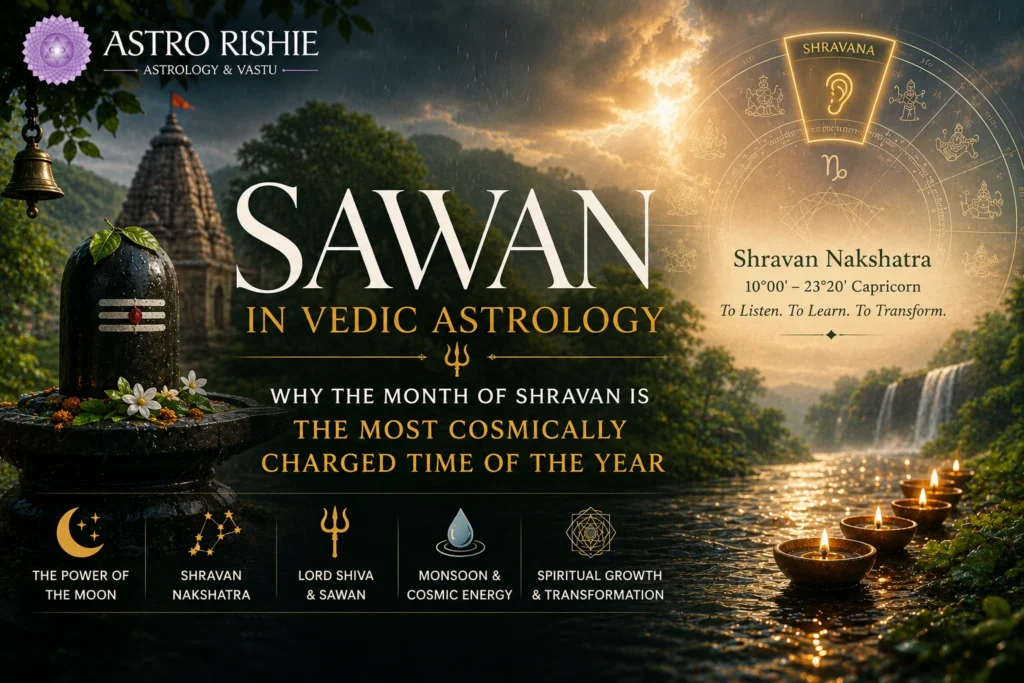
Shravan, the Sanskrit word for this month, got its name from the Nakshatra called Shravana meaning “to listen” or “the ear.” This Nakshatra is observed during the Full Moon of this month and is located at 10°-23°20′ of the Sidereal Capricorn.
Based on the Gregorian calendar, Sawan falls anywhere between mid-July and mid-August, although there is an annual slight variation based on the lunar cycles. It is the fifth month in the Hindu calendar, the month during the peak of the monsoon, when there is heavy rain pouring on the earth.
The month contains four or five Somvars – Mondays – and it is these Mondays in particular that hold special astrological weight. We’ll return to why shortly.
The Nakshatra of Shravan: The Star of Listening
To understand the power that this planet has in astrology, you need to understand the Nakshatra that it is named for.
In Vedic astrology, there are 27 Nakshatras, or lunar mansions, covering exactly 13°20′ of the zodiac each. This system of divisions in astrology is one of the oldest known, pre-dating the 12 signs of the zodiac, and it is believed to give more detailed information than just knowing the sign.
The Moon moves through all 27 Nakshatras in 27.3 days, taking about one day to move through each Nakshatra. There is a deity, a symbol, a ruler, and a particular energy associated with each Nakshatra.
Shravana Nakshatra – the star that gives this month its name — sits in Sidereal Capricorn and is governed by the Moon itself. Its presiding deity is Vishnu, the preserver, the one who maintains cosmic order. Its symbol is three footprints — representing the three great strides of Vamana, Vishnu’s dwarf avatar, who measured all three worlds in three steps. Some texts also associate its symbol with the human ear.
Its quality – its guna – is Rajas, the energy of activity and transformation. Its primary motivation is Artha – the pursuit of meaning, purpose, and right livelihood.
Shravana’s energy is fundamentally about receiving. About listening deeply – not just with the ears but with the full faculty of consciousness. The word Shravan derives from the Sanskrit root śru, meaning “to hear.” In the Vedic tradition, the highest learning doesn’t come from reading or debate – it comes from shravan, the act of deep, attentive listening to that which is being transmitted from a higher source.
The month named after this Nakshatra, in Jyotish, inherits this quality at a collective level. Sawan is considered a period when the cosmos itself is transmitting – and the capacity to receive that transmission is heightened.
The Sun’s Position During Sawan: Cancer and Its Significance
Though the Moon Nakshatra determines Shravan’s name, it is the location of the Sun in that particular month that decides its astrological nature.
In Sawan, the Sun passes through Sidereal Cancer or Karka in Sanskrit. This is immensely important in Jyotish due to various interconnected factors.
The zodiac sign associated with Cancer is that of the Moon.
This means that the Moon is the ruler of Cancer. In other words, Cancer is the Moon’s home, which signifies that the power of the Moon is fully harnessed in this sign. When the Sun transits Cancer, it enters the world of the Moon and the energies associated with it become amplified through this process, as far as the emotions and intuition, among other qualities, are concerned.
The Sun is not at ease in the sign of Cancer. The Sun is exalted in the sign of Aries and is considered to be in neecha in the opposite sign of Libra. Although Cancer is not considered a fall sign for the Sun, this does not mean that there is no weakening of the Sun’s energy when it moves into this particular sign. In Cancer, the Sun moves inward and becomes quieter.
This is the constellation that is associated with water, nutrition, and the divine mother. According to the system of Jyotish, the Cancerian rules the chest and heart, home, ancestry, and all the things associated with nurturing. The passage of the Sun through the Cancer constellation during the monsoon season, when there is an abundance of literal water from the sky, is a perfect match of the symbol with nature. In the Vedic thought, this is no accident. This is the physical manifestation of the cosmic order.
Why the Moon Is Central to Sawan?
If you understand one thing about Sawan’s Vedic astrological significance, let it be this: this is fundamentally a lunar month.
The Moon is the presiding luminary of Sawan in a way that no other month quite replicates. The Nakshatra is Moon-ruled. The Sun sits in the Moon’s sign. The Full Moon of the month falls in Shravana – a Moon-ruled Nakshatra. And the days considered most sacred within Sawan – the Mondays – are the Moon’s own day of the week.
In Jyotish, the Moon is the Manas – the mind, the emotional intelligence, the inner world. It represents consciousness itself in its receptive, reflective form. It is the planet closest to the Earth and the one that affects human life most directly and immediately. Every Nakshatra the Moon transits carries that Nakshatra’s energy into the collective experience of that day. And during Sawan, the entire month is held within a lunar framework that amplifies the Moon’s qualities exponentially.
What are those qualities? Receptivity. Emotional depth. Heightened intuition. A natural turning inward. A softening of the ego’s grip. An increased permeability to what might be called the subtle – prayer, devotion, spiritual transmission, the felt sense of the sacred.
These are also, not coincidentally, the qualities that make spiritual practice most potent. You don’t receive when you’re completely in your rational, outward-facing mind. You receive when the Moon-mind is active – when you’re quiet, open, emotionally honest, and present.
Sawan, astrologically, is the month when the cosmos aligns to make that receptive state most accessible.
Somvar: Why Monday Carries So Much Weight During Sawan
The Somvars – Mondays – of Sawan are regarded as particularly auspicious, and this also has sound astrological basis.
As per Vedic astrology, every day of the week corresponds to a particular planet. Monday’s Sanskrit name is Somvar where Soma refers to one of the oldest names of the Moon. (Another meaning of Soma includes a sacred drink of the Vedic era known for its divine properties of enlightenment and immortality. Thus, there have been many layers of associations between the Moon and Soma.)
The Moon rules over Monday. The energy of the Moon is best available on Mondays all through the year. In case of Sawan, as the whole month works under a powerful lunar regime, the lunar energy of Monday does not simply get amplified but gets multiplied.
It is like a resonant effect. The month is lunar. The day is lunar. The Nakshatra is lunar. The Sun is placed in the zodiac sign of the Moon. These are all frequencies overlapping, but what is rare in the Vedic calendar is that they overlap on the Somvars of Sawan.
In Jyotish, however, the idea of having all these planetary forces working together, so that the same quality is enhanced in this way, is an important one. It is what makes up the concept of Yoga creation in Vedic astrology; when planets come together, or when certain things happen simultaneously, there is a new quality created in the totality.
The Somvars of Sawan are, from the point of view of Vedic astrology, a Yoga of Moon enhancement. The qualities of the Moon – devotion, receptivity, emotionality, intuition – are available in a way that is not present in any other period of the year.
Lord Shiva and the Moon: An Astrological Connection
However, the connection between Sawan and Lord Shiva is not accidental from an astrological perspective too. Shiva and Moon have been connected in various ways since the times of myths and Jyotish, and this is one of the loveliest connections that links devotionals and astrologers.
Indeed, Lord Shiva always wears the crescent Moon in his tangled hair. Here, the Moon is literally a part of him. In fact, the Moon in this iconography is not just decorative; it has a specific symbolism.
According to the myths of Vedic lore, the Moon, Chandra, ended up in the hair of Lord Shiva through a particular myth. Chandra was cursed by his father-in-law, Daksha, to become weak and die. Due to his partiality towards some of his 27 wives (the 27 wives being significant because they represent the 27 Nakshatras – the wives of the Moon are in reality the lunar mansions themselves). Chandra went to seek shelter with Shiva, who welcomed him into his hair, where he is waxing and waning even till today through each month, under the protection of Shiva.
The cosmic symbolism in this myth is profound. Shiva is the lord of the Moon. The lord who protects the principle of mind and emotion and consciousness. In Jyotish, whenever the Moon is afflicted by malefic influences and planetary transits and Dasha periods, it is the energy of Shiv. It is called upon to bring peace and clarity to the mind.
For this reason, the lunar month has the strongest lunar energies. It is the month that is strongly connected to Shiva. Shiva and lunar month cannot be separated from each other because they go hand in hand. The most intense lunar month is in the sacred month of Shiva.
The Nakshatras Active During Sawan: A Month-Long Journey
As it takes twenty-seven days for the moon to traverse all the 27 Nakshatra, the entire Nakshatra cycle is completed within the month of Sawan. The significance of each day changes as it represents a unique Nakshatra vibration.
A few of the Nakshatras active during Sawan carry particular significance in Jyotish:
Punarvasu (Gemini/Cancer cusp): Puna means “return” and vasu means “light” or “wealth.” This Nakshatra carries the energy of restoration and renewal – the return of what was lost. It’s governed by Jupiter and its deity is Aditi, the goddess of infinity and the mother of the gods. Days when the Moon transits Punarvasu during Sawan carry a quality of recovery, abundance, and expansion after a period of difficulty.
Pushya (Cancer): Widely considered the most auspicious Nakshatra in the entire zodiac in Vedic tradition. Its name means “to nourish” or “to flourish.” Governed by Saturn and with Brihaspati (Jupiter) as its deity, Pushya carries the energy of pure nourishment. It is for receiving what the soul genuinely needs. The Moon is considered exceptionally well-placed in Pushya. When Somvar and Pushya Nakshatra coincide during Sawan – creating what’s known as Somvar Pushya Yoga. This is regarded in Jyotish as one of the most potent lunar alignments in the entire year. A moment when the nourishing, amplifying, and receptive qualities of both the Moon’s day and its most nurturing Nakshatra combine.
Ashlesha (Cancer): The final Nakshatra in Cancer, governed by Mercury, with the Nagas (serpents) as its deity. Ashlesha carries penetrating, transformative energy – the kind that sees through illusion and clears what is not genuine. It’s a complex, powerful Nakshatra, associated with deep psychological insight. It has the ability to cut to the truth of any matter. Days when the Moon transits Ashlesha during Sawan bring a particular intensity to inner reflection.
Magha (Leo): The first Nakshatra in Leo, governed by Ketu and associated with the ancestral realm – the Pitrs, or departed ancestors. Magha carries the energy of royal authority and ancestral honouring. The Moon’s transit through Magha during Sawan activates the themes of lineage, inheritance, and honouring those who came before.
Shravana itself (Capricorn): The Full Moon of Sawan falls in this Nakshatra – the apex of the month. When the Full Moon rises in Shravana, the Moon is in its most powerful monthly phase (full illumination) in the Nakshatra. It is governed by the Moon itself, in the month named after that Nakshatra. The layers of lunar resonance at this Full Moon are, in Jyotish terms, remarkable.
The Monsoon, the Earth, and Jyotish: When the Outer Mirrors the Inner
One of the most striking aspects of Vedic astrology is how consistently the cosmic and the earthly mirror each other. Jyotish doesn’t treat the universe as separate from nature – it treats them as expressions of the same underlying order.
The monsoon arrives during Sawan. After months of scorching heat, the earth opens. The rains come. The ground that had been parched and hard softens and becomes receptive. Seeds that had been lying dormant germinate. Life, literally, returns.
In Jyotish, this isn’t background scenery. It’s the earthly expression of what’s happening cosmically. The Sun in Cancer – the Moon’s watery, receptive sign reflects the earth’s own opening to water. The Moon-amplified atmosphere of the month reflects the heightened receptivity of the natural world. The metaphor isn’t decorative; it’s structural. The same principle that makes the earth receptive to rain during Sawan makes the human consciousness – particularly the lunar, emotional, intuitive aspect of consciousness – more receptive to what the cosmos is transmitting.
This is the Vedic principle of macrocosm and microcosm. As above, so below. The earth receiving the monsoon and the soul becoming more permeable to the sacred are not two different events. They are the same event, expressed at different scales.
Sawan and the Nakshatra of Your Moon: Personal Resonance
Although Sawan is endowed with general astrological significance, the month also bears personal significance to the individual based on the position of the natal Moon in their Vedic horoscope.
Although Sawan is endowed with general astrological significance, the month also bears personal significance to the individual based on the position of the natal Moon in their Vedic horoscope.
If your natal Moon is placed in Cancer – the sign the Sun occupies during Sawan – this month tends to bring particular intensity and heightened sensitivity for you. The solar transit of your Moon’s sign creates a kind of emotional amplification that can feel both raw and extraordinary.
If your natal Moon is in Shravana Nakshatra – making you a Shravana Moon native – the Full Moon of Sawan falls close to or on your natal Moon degree. In Vedic astrology, a Full Moon on or near your natal Moon position is considered one of the most significant lunations of the year for you personally. There’s a quality of culmination, illumination, and emotional intensification that tends to accompany it.
If your natal Moon is in Pushya Nakshatra, any Somvar when the transiting Moon passes through Pushya during Sawan creates a personal Pushya Yoga for you – a brief but potent window of lunar amplification that astrologers regard as excellent for turning inward, for meditation, for anything that requires clarity of the mind.
And if your Moon Mahadasha or Antardasha is currently active in your Vimshottari Dasha cycle, Sawan takes on additional personal significance. The Moon period in the Dasha system is already heightening lunar themes across all areas of your life. Sawan, arriving within an active Moon period, creates a convergence that Jyotish practitioners take seriously as a particularly significant period of inner life and spiritual development.
The Astrological Reason Sawan Demands Sattvic Living
For those who practice Sawan culture, their natural inclination is to become more disciplined, introspective, and sattvic in their behavior throughout the month by eating less, living simply, having fewer sensory experiences, and spending more time in prayer.
Astrologically speaking, following this discipline throughout the month makes sense from an intelligent perspective.
As per the Vedic philosophy, three Gunas, which are Tamas (inertia), Rajas (activity) and Sattva (clarity and harmony), are all present in everything around us, including our food, environment, relations and mental states. In Jyotish, the moon is connected to the sattvic nature – with clarity and purity and the ability to really be receptive.
The sattvic way of living will facilitate the Moon’s nature. Eating heavy foods, being overly stimulated by sensory input and overactivity – all these things bring more tamas and rajas into our lives, and both of them pollute the nature of the Moon and decrease our inherent ability to be receptive.
If the whole month itself is geared toward magnifying lunar, receptive, sattvic energy, then in terms of Jyotish, the traditional rituals. These are carried out in Sawan – such as fasting or light eating, abstaining from meat, being outdoors more. These are ways of going with the cosmic forces rather than against them.
Sawan can be thought of as a naturally occurring window of time. At this time, the conditions are optimal for doing inner work. Living in tune with the energies is not a form of self-denial; it’s a form of resonance.
Sawan in 2026: The Astrological Context
During the year 2026, Sawan will begin on 30 July and will end on 28 August, and there will be five Somvars – Mondays – namely 3 August, 10 August, 17 August, 24 August, and in some regional Panchangs.
Curious about how this Sawan’s planetary alignments interact with your personal Vedic birth chart – including your natal Moon, current Dasha period, and which Nakshatra transits are most significant for you this month? Book a personalised Jyotish reading with Astro Rishie