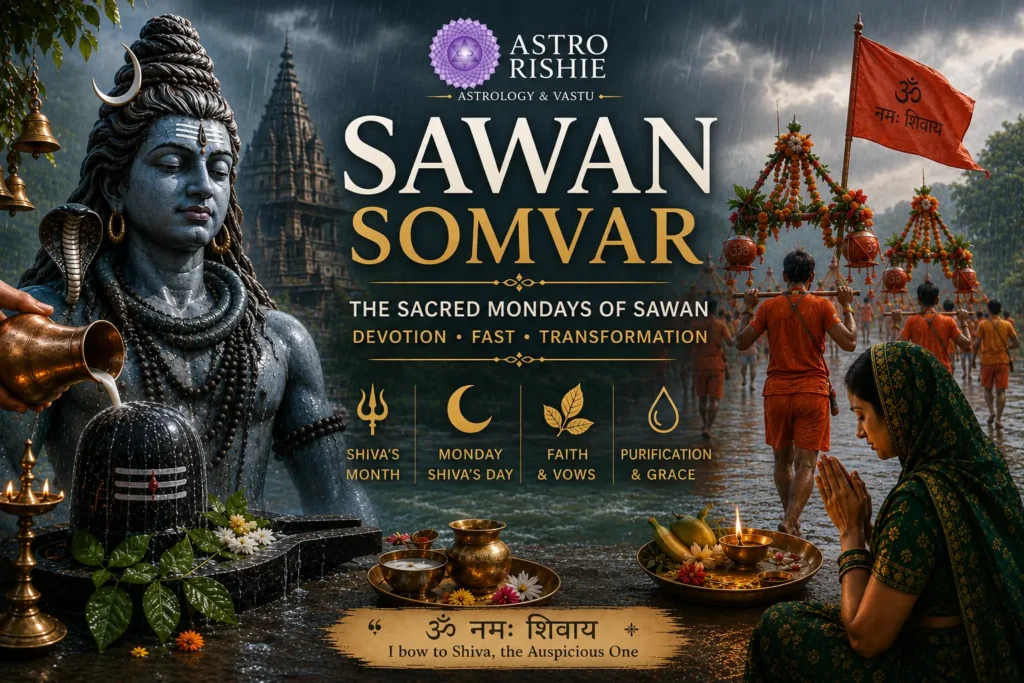
Every year, when the monsoons are established over the Indian subcontinent and the air has the distinct weight of midsummer rains, there comes one other thing – the month of Sawan, which is also known as Shravan according to the Vedic Calendar. In addition, during the month of Sawan, there are some Mondays whose importance makes millions of devotees throng various temples and ghats along rivers.
These special Mondays are referred to as Sawan Somvar, with Somvar meaning Monday in Hindi, an appellation which is rooted in the Sanskrit word Soma, which refers to Lord Shiva. However, in order to comprehend why these specific Mondays are so important, it is imperative that one first comprehends what the month of Sawan is all about.
What Is the Month of Sawan?
Sawan or Shravan is the fifth month according to the Hindu lunar calendar, generally occurring between the months of July and August in the Gregorian calendar. The month of Sawan is said to be the holiest month in the Shaivite sect, wherein this month witnesses an unmatched divine energy which cannot be found in any other month.
The month is steeped in references about Shiva in the Vedic and Puranic literatures. Some of the stories associated with the month of Sawan are the Samudra Manthan, which means churning of the cosmic ocean undertaken by both Devas and Asuras to find the immortal elixir. While churning, a highly toxic substance called Halahala was released out of the ocean and would have destroyed all of creation. To save creation from being destroyed, Lord Shiva drank the poison and kept it in his neck, which turned blue.
Why Are Mondays Especially Sacred in Sawan?
Monday belongs to Shiva in the Vedic calendar system. This relationship has much to do with the word itself – “Soma” (moon) is among the names of Shiva, and the moon has a unique significance in the mythology of Shiva – the crescent moon adorns his matted hair denoting his control over time.
It is because Sawan is Shiva’s month and Monday is Shiva’s day that the Mondays in the month of Sawan, known as Sawan Somvar, have an elevated sanctity of their own. It is an intersection between the most sacred month of the year and the most sacred day of the week according to Shaivism.
In each year, the number of Mondays falling during the month of Sawan varies due to the lunar calendar and is generally four in number, although sometimes five Mondays occur in the month of Sawan.
The Tradition of Sawan Somvar Vrat
One of the most popular fasts celebrated within the Hindu community in general, and more specifically by the women community is the Sawan Somvar Vrat, the fasting that is done on Mondays during the month of Sawan.
The fast has variations based on the traditions of families, regions, or individuals. There are those who do a total fast from sunrise to moonrise, others have one meal in the evenings after praying and there are those who just consume fruits during the day.
What remains common about all of the fasting types above is the primary practice which is always worshipping of Lord Shiva through the Rudrabhishek (washing of the Shiva lingam with water, milk, honey, curds, etc.) along with offering Bael leaves which happen to be one of the favorite things that Lord Shiva likes to get offered. Also chanting of Shiva mantras especially Om Namah Shivaya and Mahamrityunjaya Mantra is also practiced.
The purpose of the vrat also differs from person to person. While many unmarried girls fast during the Sawan Somvar with the hope of getting a husband like Lord Shiva in terms of dedication, strength and knowledge. On the other hand married ladies fast for the good
Sawan Somvar in the Context of the Vedic Calendar
An understanding of the role of Sawan Somvar in Vedic astrology can be gained by analyzing what is going on astronomically during this time. In the Shravan month, the Sun transits Cancer (Karka Rashi), and Cancer happens to be the exalted sign of the Moon. The energy of the Moon is at its peak during this time, which makes the importance of Monday (the day of the Moon) during this time very high.
The Moon rules the mind, emotions, intuition, and the ability to receive things in Vedic astrology. Due to the increase in lunar energy, this time is considered very auspicious for prayers and meditation since the mind becomes very receptive during this time, and any intentions made during this period have special significance.
Due to this reason, this is not only a time that Shiva devotees observe, but it is also an auspicious period in the entire Vedic tradition.
Sawan Somvar Across Regions
The way Sawan Somvar is observed varies beautifully across India and among the Indian diaspora worldwide:
In North India, Sawan is celebrated with great intensity. The Kanwar Yatra is at its peak, Shiva temples are adorned with monsoon flowers, and Sawan Somvar fasts are observed with particular strictness. Shringar (decorative offerings) to the Shiva Lingam are elaborate, and the chanting of Shiva stotras fills temple courtyards from dawn.
In Maharashtra, the month is called Shravan and carries similar reverence. The Shravan Somvar fast (as it’s known locally) is observed with the Shiva puja performed at home or in the temple, and prasad in the form of panchamrit (the five sacred offerings) is distributed after the evening prayer.
In South India, while the Shaivite tradition is equally strong, the month’s observance takes regional forms – with Pradosham (the fortnightly Shiva observance) falling within Shravan receiving additional significance, and specific Shiva temples conducting extended rituals throughout the month.
Among the Indian diaspora in Australia – including the growing community in Sydney, Melbourne, and Brisbane – Sawan Som
The Spiritual Logic of the Sawan Somvar Vrat
Apart from the mythological and astrological reasons, there is an even more fundamental spiritual sense behind this vrat. Fasting and prayers lead to a temporary interruption. They force people to cease their usual rhythm of consuming things and paying attention to them and to orient on something that is beyond all desires.
During the month of the monsoons, the rain and the break of the hot weather create a natural tendency towards the inner transformation of people. The Sawan Somvar vrat is the moment when the devotee should stop, become attentive and sincere in his or her desires and wishes.
Shiva, according to the Vedas, is the deity who destroys the unnecessary so that the needed could emerge. In the same way, the Sawan Somvar vrat can be regarded as an opportunity for the same transformation.
Sawan Somvar 2026 – Dates
The Sawan Somvar dates in 2026 fall within the Shravan month as per the Hindu lunar calendar. Exact dates vary by regional calendar (Purnimant vs Amavasyant traditions), so it is always advisable to confirm with a Vedic almanac (Panchang) or your local temple for the dates observed in your tradition.
If you’d like guidance on auspicious timings, Muhurta for specific rituals during Sawan, or a Vedic consultation connected
Frequently Asked Questions About Sawan Somvar
Sawan Somvar refers to the Mondays that fall within the Hindu month of Sawan (Shravan), which typically occurs between July and August. These Mondays are considered highly auspicious in the Shaivite tradition because Monday is Lord Shiva’s day and Sawan is Lord Shiva’s month – making the combination particularly sacred for devotion and prayer.
The number varies depending on the Hindu lunar calendar for that year. Most years have four Sawan Somvar, though in some years – particularly when the month is extended or when calendar adjustments occur – there may be five.
The Sawan Somvar vrat is observed by millions of Hindu devotees across India and the global Indian diaspora. It is particul
Not exactly. While the central focus – prayer to Lord Shiva – is consistent, the specific form of the fast, the rituals performed, the foods eaten or avoided, and the timing of the prayer vary by regional tradition, family practice, and personal vow. North Indian, South Indian, and Maharashtrian observances all carry their own distinct character.
The Kanwar Yatra is a pilgrimage undertaken during Sawan in which devotees (called Kanwariyas) carry sacred water from the Ganga River to their local Shiva temple for the ritual bathing (abhishek) of the Shiva Lingam. It is rooted in the mythological story of the Samudra Manthan and Shiva’s consumption of the Halahala poison. The yatra is one of the largest religious gatherings in the world and reaches its peak during the Sawan Somvar dates.
In countries outside India, Sawan Somvar observances are typically centred on the home or local Hindu temple, where Shiva puja and abhishek are performed. The essence of the practice – fasting, prayer, and devotional offering to Shiva – remains the same. The main difference is that large-scale public observances like Kanwar Yatra are not a feature of the diaspora experience, but the personal and family dimensions of the vrat are maintained with care.